Startup
Datananas: seven years building a SaaS startup, from solo project to acquisition
The idea for Datananas came during a six-month internship at Multiposting in 2012 and 2013, where I worked as a business developer. Prospecting began with a tedious ritual: search LinkedIn or Viadeo, copy names and companies into a spreadsheet, then hunt for an email address that might work. In May 2014, while finishing my MSc in Entrepreneurship at SKEMA Business School, I turned that irritation into a company and built the first version.
Over the next seven years, Datananas grew into a twenty-person company and raised €1 million. It also came within days of running out of cash. We cut the team to four, rebuilt the business and returned to profitability before Sarbacane acquired it in 2020.
I saw quite early where sales software was going. I was slower to understand how fragile a company becomes when its payroll grows faster than the predictability of its revenue. Datananas taught me both lessons, although it charged considerably more for the second one.
2014–2017: the List Builder years
The first product was called Datananas List Builder. It sat beside LinkedIn or Viadeo and let a salesperson collect profiles into a prospect list. Datananas then tried to find the professional email address behind each profile. It was the first product built around that complete workflow.


The embarrassing design of the first Datananas List Builder, preserved in a 2015 walkthrough.
That sequence feels obvious now because prospecting tools have copied it so thoroughly. In 2014, browser automation and email enrichment were still unusual in sales software. Marketing teams already had plenty of SaaS products; sales teams had almost nothing beyond the CRM, which recorded their work but did little to help them do it. The earliest demo I have recovered dates from May 2015. Its interface has aged without unnecessary dignity, but the product idea is already there.
I wrote the code, sold the product and answered support. Customer complaints reached the person who could fix them without passing through three departments, mostly because there were no departments. That direct loop made the product move quickly: a customer could report a problem in the morning and see the change soon afterwards.
Recurring revenue, month by month
January 2015 — March 2016 · monthly recurring revenue (€)
| Month | Monthly recurring revenue |
|---|---|
| Jan 2015 | €404 |
| Feb 2015 | €809 |
| Mar 2015 | €1,682 |
| Apr 2015 | €2,130 |
| May 2015 | €2,254 |
| Jun 2015 | €2,516 |
| Jul 2015 | €3,073 |
| Aug 2015 | €5,003 |
| Sep 2015 | €5,200 |
| Oct 2015 | €6,028 |
| Nov 2015 | €6,600 |
| Dec 2015 | €8,615 |
| Jan 2016 | €11,060 |
| Feb 2016 | €12,285 |
| Mar 2016 | €13,758 |
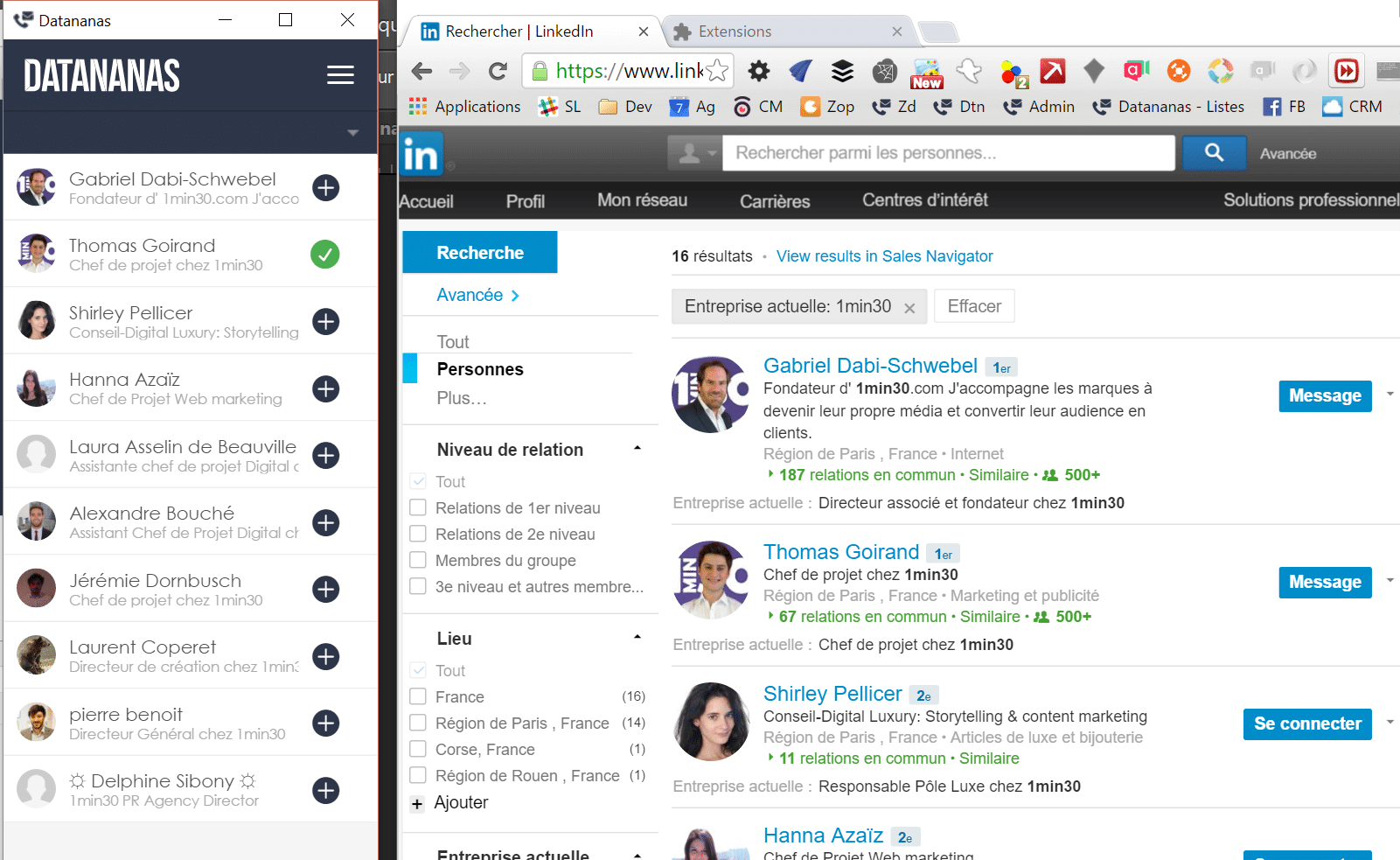
Datananas List Builder running alongside LinkedIn search results, in 2016.



A co-founder joined in 2016 and became CEO, while I moved into the roles of CPO and CTO and continued to lead product and technology.
We also stopped self-service and made Datananas entirely sales-led. Instead of subscribing on their own, customers bought annual plans through our sales team.
At first, the decision worked. Annual contracts brought in cash upfront, which allowed us to recruit and grow the team. We raised a €1 million seed round and expanded until Datananas had about twenty employees.
The model also changed the economics of the company. Only about 60% of each contract paid for the software itself; contact data and training made up the rest.
Bookings produced cash, but they arrived in waves. A strong month could finance more hiring without making the next one any easier to predict. Payroll maintained a much steadier sense of punctuality.
September 2017–January 2018: the forced pivot to Outbound
List Builder had a weakness that no amount of product work could remove: LinkedIn and Viadeo owned the ground under it. Shortly before Microsoft acquired LinkedIn, LinkedIn sent us a cease-and-desist letter. My interpretation is that they wanted to look clean before the deal. I cannot prove it, but the timing was hard to ignore.
In September 2017, we began building Datananas Outbound. By January 2018, the cease-and-desist forced us to stop selling List Builder outright. The second product had to take over immediately.
That was not an even handover. List Builder was highly profitable and its value was obvious at first sight: select a profile, get a professional email address. Outbound belonged to a category that barely had a name.
It sent prospecting emails from a salesperson's own Gmail account, organized them into sequences and automated the follow-ups. We first had to explain why this was not email marketing.
Then we had to explain why a sequence of plain, personal emails worked better for prospecting than an HTML campaign. Today that distinction is familiar. In 2018, making the market understand it was part of every sale.
For Outbound, we copied SalesLoft's commercial model: no self-service, annual contracts only and no way to try the product. But we copied it into a much less mature market.
In the United States, sales teams already had specialized SDR and account executive roles. In France, salespeople were more often generalists responsible for the whole cycle. The workflow Outbound formalized was not yet standard.
That made sales cycles long. Outbound had also been built under a hard deadline and the first version was buggy. Prospects had to buy an annual contract without being able to try it first.
The gap between the promise and that first experience created disappointment at precisely the moment when we also had to convince the market that the category itself made sense.
I had already become convinced that AI could remove some of the repetitive judgment from sales work. Smart Replies detected an answer from a prospect, classified the kind of response and prepared the appropriate reply template. We also detected out-of-office messages, extracted the return date and scheduled the next email for when the prospect was back. Generative AI had not yet become a standard product pitch; we were already trying to make software understand what had happened and decide what should happen next.
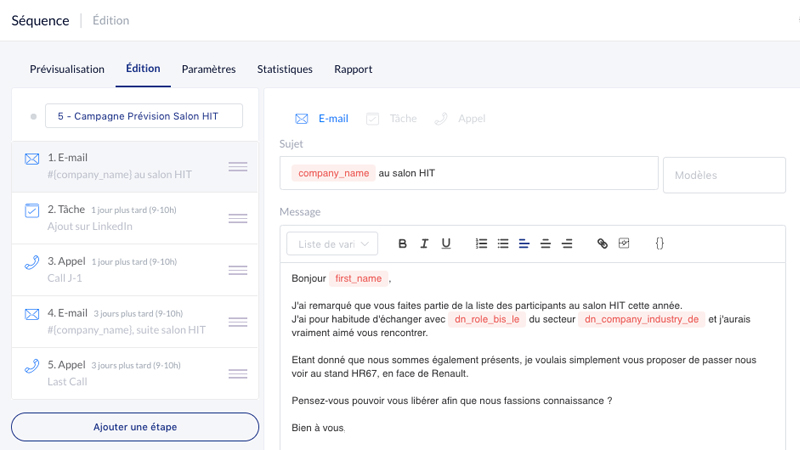
The Datananas Outbound sequence editor in 2018.
SalesLoft was making almost the same journey in the United States, moving from prospecting data to outbound sales workflows. Outreach was the other large competitor in the emerging sales engagement category. SalesLoft had started at roughly the same time as Datananas, then raised far more money and grew into a much larger company. We had less room to absorb the cost of changing products while carrying a twenty-person team.
December 2018: the cash crisis
In December 2018, Datananas booked six figures in sales, our best month ever. We were also close to running out of cash. The apparent contradiction came from the way we sold: annual contracts closed by a sales team could produce an excellent month without making the next one any easier to predict. We had hired as if the revenue underneath those bookings were already regular, which it was not.
The pivot made the mismatch worse. We were paying for an organization built around List Builder while Outbound still needed product work and a market that understood it. We explored another funding round and a possible acquisition, but neither could happen in time. Some of our investors agreed to issue convertible bonds after we committed to reducing the burn. Without that bridge, the company would have run out of cash within days.
About 80% of our costs were salaries, which left no painless place to cut. In the first round we let roughly half the team go and reduced Datananas to fewer than ten people. More employees left over the following months through departures and mutual agreements. We had made the hiring decisions; people who had not made them paid the price.
One developer answered his dismissal by offering to work outside his original role and take a lower salary if that would help the company survive. He could easily have found another job. His response has stayed with me because it arrived at the point when abandoning the company would have been understandable, and it convinced me to keep going. By the end of 2019, four core people and an intern remained.
2019: rebuilding with four people
The old sales process could not survive with four people, so we removed every part of the company that required an army behind the curtain. Customers could start a free trial without requesting a demonstration. Monthly self-service plans replaced annual contracts, and users handled more of their own setup and account management. Necessity led us to product-led growth before it became a slide in every SaaS deck.
The same constraint changed engineering. We narrowed the product and stopped allowing bugs to wait behind an ambitious roadmap. The average time an issue stayed open fell from about thirty days to two. A team with roughly a third as many developers handled about twice as many issues, largely because fewer priorities were competing for the same attention.
I worked on product and technology with one back-end developer, while a customer success manager stayed close to users. There was nowhere for ownership to disappear. Lower costs and a product that customers could try and buy without a sales call brought Datananas back to profitability.
2020–2021: the acquisition and my departure
Sarbacane acquired Datananas in 2020, and I stayed as CTO until June 2021. By then the company was profitable again, with a product and an organization that bore little resemblance to the one we had built at the height of the funding round.
I would still build List Builder. It solved a real problem, and its early growth justified the bet. I would treat the dependency on LinkedIn as an expiry date rather than a distant risk, and I would wait longer before building a twenty-person payroll around enterprise bookings that arrived in waves.
Starting Datananas alone kept me close to the product because there was no distance available. The larger company taught me that headcount can make a business look more mature than its economics. Rebuilding it with four people changed how I think about software companies: every process eventually becomes somebody's job, and a small team cannot afford many jobs that the product should be doing.
When I left in June 2021, seven years after writing the first version of List Builder, Datananas was profitable and part of Sarbacane.